

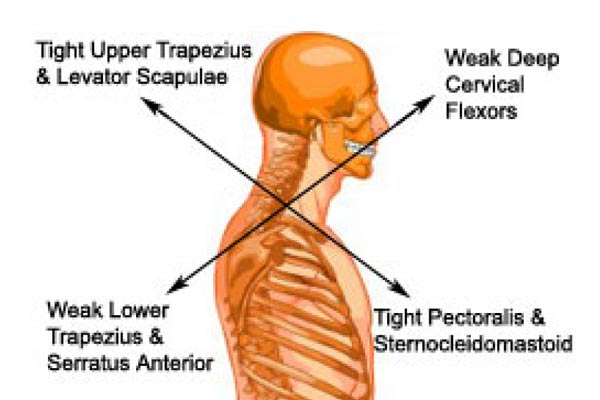
When muscle imbalances occur some muscles become inhibited and weak, while others become tight. Such imbalances lead to tissue changes that may result in inappropriate patterns of movement.
Symptoms
-Chronic neck pain and stiffness
-Chronic upper thoracic pain
-Constant symptoms
-Aggravated by reading, poor posture and by prolonged sitting
-Associated with micro-traumatic shoulder injuries
Signs
-Postural examination tends to reveal a marked anterior head carriage
-Upper cervical hyperextension
-Elevated and protracted shoulders (rounded)
– hyper-kyphotic thoracic spine
-Increased lumbar lordosis
– levator scapulae, upper trapezius, subscapularis, pectoralis minor and supraspinatus muscles becomes tight.
-Postural overdevelopment of these muscles create a deltoid shear (crossing of rotator cuff under AC joint), leading to shoulder impingement, tendonitis and bursitis syndromes.
-Cervical ranges of motion restrictions with the report of pulling muscular pain elicited at the end ranges
-Positive Cervical Kemp’s test bilaterally
-Thoracic ranges of motion restrictions
-Tender myofascial trigger points in the suboccipital, SCM, levator scapulae, and upper trapezii muscle groups bilaterally
Muscles affected
Tight muscle:
-Pectoralis minor and major
-Anterior scaleni
-Upper trapezius
-Levator scapulae
-Teres major
Weak muscle:
-Serratus anterior
-Lower trapezius
-Teres minor
-Infraspinatus
-Longus colli
Treatment
SHORT TERM GOALS:
-Postural Correction
-To reduce muscle spasm
-To increase muscle flexibility
LONG TERM GOALS:
-To release taut band
-To increase joint ROM
-To increase muscle strength
Physiotherapy techniques Included for treatment
:
– Mobilisation
-Trp
-Stretching
-Myofascial Release
-Strengthening exercises
Dr Sumit Gupta
Physiotherapist
Bangalore Shoulder and Sports Medicine Institute
More reading
 Sports Trauma
Exercise and sports are excellent lifestyle choices to maintain physical strength and overall good health. However,…
Read More
Sports Trauma
Exercise and sports are excellent lifestyle choices to maintain physical strength and overall good health. However,…
Read More
 Common Swimming Injuries | Sports Medicine Doctor, Bangalore
Swimming is one of the popular sports and physical activities that people of all ages enjoy.…
Read More
Common Swimming Injuries | Sports Medicine Doctor, Bangalore
Swimming is one of the popular sports and physical activities that people of all ages enjoy.…
Read More
 Fear of Re-injury in Athletes
For all athletes, getting injuries is an unfortunate reality that may cause disturbance in their training,…
Read More
Fear of Re-injury in Athletes
For all athletes, getting injuries is an unfortunate reality that may cause disturbance in their training,…
Read More
 Common Shoulder Injuries in Cricket – Causes and Prevention
Cricket is one of the popular sports played across the world. It involves various physicalactivities that…
Read More
Common Shoulder Injuries in Cricket – Causes and Prevention
Cricket is one of the popular sports played across the world. It involves various physicalactivities that…
Read More