

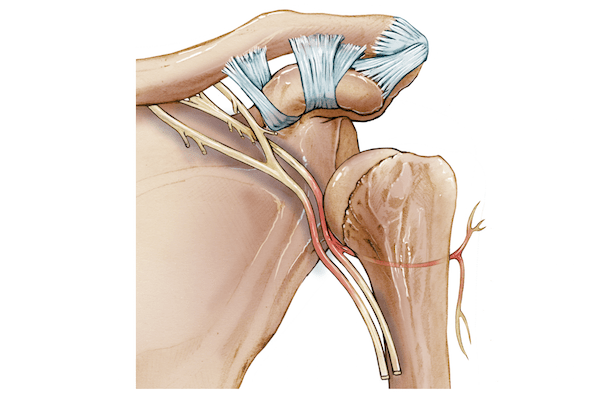
Axillary nerve palsy is a condition marked by loss of movement or sensation in the shoulder area. There are so many reasons for axillary nerve palsy, but the prominent one is shoulder dislocation. Axillary nerve’s close proximity to the shoulder capsule puts it at risk for injury. It is also known as axillary neuropathy and mononeuropathy as it is a problem with just one nerve. Excessive stress or damage to the axillary nerve, which serves the deltoid muscles and skin of the shoulder, causes axillary nerve palsy. Dysfunction of the axillary nerve can occur in the myelin sheath which provides covering and protection of the nerve.
Different symptoms can be seen in patient with axillary nerve palsy. Some patients may complain that they cannot bend the arm at the elbow; however they may not have any other signs or symptoms of nerve palsy. The diagnosis is further complicated as the onset of the palsy is delayed and may even go unnoticed for one to two years post shoulder dislocation. To correctly identify the disease, it is important to understand the symptoms and the fact that different people have different symptoms.
In fact, axillary nerve palsy is a well recognized complication of a shoulder dislocation. The good news is it is often a low-grade injury which progresses to full recovery without intervention. But there are a small number of people who may have a high-impact injury so there is less likelihood for a full functional recovery without surgical exploration and reconstruction. Early identification of patients with high-grade injury leads to rapid referral to peripheral nerve centers allowing specialist observation or surgical intervention at an early stage; this in turn will result in maximum recovery.
Shoulder dislocation is a common injury associated with low- and high-impact trauma. As a result of this, axillary nerve may feel suppressed, leading to nerve damage. People who are active in sports and elderly individuals are two groups who are prone to shoulder dislocation and the resultant axillary nerve palsy. Risk of axillary nerve palsy increases with age. In those aged over 40 years, about 65% of total shoulder dislocations may cause axillary nerve palsy. Presence of fracture during shoulder dislocation doubles the risk of nerve palsy. You are at a higher risk for shoulder dislocation and the subsequent axillary nerve palsy if you:
- are an athlete or someone who participates in high-impact upper body activities
- perform repetitive tasks using your shoulder
- have a certain type of existing bone fracture
- improperly use supportive equipment such as crutches
Symptoms of axillary nerve palsy:
If you have axillary nerve palsy, you may have:
- feel numbness or tingling in the shoulder region
- have weakness in the shoulders
- have problems with normal physical activities, such as lifting your arms above your head
- have difficulty lifting objects
- reduced volume of the shoulder muscles
Diagnosis of axillary nerve palsy:
Your doctor will perform a physical examination and ask questions to figure out if you are having problem with your axillary nerve. Your pain sensitivity throughout the upper body will be checked by having you raise your arms. Your doctor may also ask about any prior trauma to the shoulder, deltoid muscles or anything else in the area of the axillary nerve. The doctor might also ask if you have used crutches or other support devices to see if there are any stresses that damaged the axillary nerve. Your doctor may recommend certain tests such as electromyography (EMG) to see the status of the axillary nerve. However, this test should not be done immediately post injury as the results will be normal. It need be done weeks after the initial injury and the onset of symptoms. Your doctor may recommend an MRI and an X-ray.
Treatment of axillary nerve palsy:
More often than not, recovery happens spontaneously and no treatment is needed. For mild to moderate axillary nerve palsy physical therapy and changes to daily routine may do the trick. Specific exercises can help muscle groups improve the nerve damage and preserve nerve function. If there are swelling and inflammation around the axillary nerve area, your doctor may prescribe anti-inflammatory medications to combat the swelling or inflammation that may be putting pressure on the axillary nerve.
In majority of cases, effective medical treatment can cure axillary nerve palsy. The outcome depends on the extent and nature of the nerve damage happened. At times and trapped nerve may need surgical repair to restore its normal function. Surgery is generally considered if there is no restoration of the nerve function even after six months of treatment. Some surgical options include nerve grafting, neurolysis or nerve reconstruction.
For questions related to Axillay Nerve Injury and shoulder dislocation, send a message to www.BangaloreShoulderInstitute.com/contact
Q & As on Axillary Nerve Palsy
1.What is the function of the axillary nerve?
The axillary nerve is also called the circumflex nerve. It is one of the five peripheral nerves that run through the shoulders. The axillary nerves originate at the neck at the brachial plexus.
The axillary nerve helps in the movement of the upper limbs near the shoulder. These nerves also provide sensations like pain, touch, and temperature to the shoulder area. This means that the axillary nerve functions both as motor and sensory nerves. It stimulates three muscles in the arm: the deltoid, the triceps’ long head, and teres minor.
2.What is axillary nerve palsy?
Axillary nerve palsy is a neurological condition wherein the axillary nerve is damaged due to a dislocation of the shoulder. This can be due to a direct injury to the nerve, long-term pressure affecting the nerve, or a shoulder injury. There is a loss of movement or sensation in the shoulder when this happens. Since the problem is localized and pertains to one nerve, it is also called axillary neuropathy or mononeuropathy. As the axillary nerve is located close to the shoulder capsule, the risk of injury is more.
3.What are the symptoms of axillary nerve palsy?
Patients suffering from axillary nerve palsy show different symptoms. Some people say they are unable to bend the arm at the elbow. They may not have any other symptoms which may delay the diagnosis. The other symptoms that lead to a proper diagnosis of the condition are:
- Numbness or a tingling sensation in the shoulder area for quite some time.
- Issues with normal activities involving the shoulder like lifting the arms above the head.
- Problem with lifting objects
- The volume of shoulder muscles is getting reduced.
In severe injuries, there may be a complete lack of movement or feeling in the arms too.
4.How do you know if you are at risk of axillary nerve palsy?
You are at risk of axillary nerve palsy, if you:
- are a sports person or an athlete who takes part in high-impact activities involving your upper body.
- perform repeated tasks using your shoulder.
- are aged and have a fracture of the bone in the shoulder.
- use support equipment like crutches in an improper way.
There is a higher risk of axillary nerve palsy in aged people since nearly 65% of shoulder dislocation in people over 40 years can result in this situation.
5.What is the treatment mechanism for axillary nerve palsy?
With effective treatment, axillary nerve palsy can be cured well. But, this also depends on the degree of damage caused. If the condition is mild to moderate certain physical therapy can help in recovery. Exercises that can restore nerve functions may be prescribed by the doctor. If swelling persists around the nerve area, anti-inflammatory drugs may be prescribed. If, even after 6 months of preliminary treatment, there is no improvement, then surgery may be prescribed. This can include nerve grafting, neurolysis, and nerve reconstruction.
6. What is axillary nerve palsy after a shoulder dislocation?
Axillary nerve palsy is a nerve injury that can happen when the shoulder dislocates, particularly after the shoulder slips forward out of the socket. The axillary nerve travels very close to the shoulder joint so that it can become stretched, bruised, or compressed during the injury. This nerve helps control the deltoid muscle, which is important for lifting the arm away from the body, and it also provides sensation to part of the outer shoulder.
Patients often notice weakness when trying to raise the arm, along with numbness or altered sensation over the upper outer aspect of the shoulder. In some cases, the weakness is mild and improves gradually, while more severe injuries may take longer to recover.
7. How do I know if my shoulder dislocation has damaged a nerve?
Persistent weakness after the shoulder has been relocated can suggest nerve involvement. Many patients assume the arm feels weak simply because of pain, but axillary nerve injuries usually produce a distinct difficulty lifting the arm sideways, even after the initial pain begins to settle.
Another common symptom is numbness or tingling over the “regimental badge” area, which is the patch of skin on the outer shoulder. Some patients also notice the shoulder muscles appearing flatter over time if recovery is delayed. If weakness or altered sensation continues beyond the early stages after dislocation, further assessment is important to evaluate nerve function properly.
8. Can axillary nerve palsy recover without surgery?
Yes, many cases recover without an operation. The majority of axillary nerve injuries associated with shoulder dislocation are stretch injuries rather than complete nerve tears. In these situations, the nerve often heals gradually over weeks to months.
The length and course of recovery largely vary according to how severe the injury is. Mild nerve bruising may improve relatively quickly, while more significant injuries can require a longer rehabilitation period. Physiotherapy is usually an important part of treatment because prolonged weakness can lead to shoulder stiffness and muscle wasting. Careful monitoring is essential so that delayed recovery or persistent nerve dysfunction is recognised early.
9. Why does my shoulder still feel weak months after the dislocation?
Ongoing weakness may occur because the nerve has not fully recovered or because the deltoid muscle has become weakened after a reduced nerve supply. Even when pain improves, the muscles controlled by the axillary nerve may remain slow to regain strength.
In some patients, weakness is also linked to associated injuries such as rotator cuff tears, labral damage, or recurrent instability following the dislocation. This is why persistent symptoms should not simply be dismissed as part of normal healing. A detailed examination and imaging studies may be needed to determine whether the nerve, muscles, or joint structures remain affected.
10. What tests are used to diagnose axillary nerve palsy?
Clinical examination is the first and most important step. A shoulder specialist will assess muscle strength, sensation, and shoulder stability. If nerve injury is suspected, nerve conduction studies and electromyography, commonly called EMG testing, may be recommended. These tests help evaluate how well the nerve is functioning and whether recovery is taking place.
MRI scans can also be useful, especially if there is concern about additional shoulder injuries. Since shoulder dislocations can damage several structures at the same time, imaging often helps build a clearer picture of the overall injury pattern.
11. Is numbness over the shoulder always caused by axillary nerve injury?
Not always, but it is a common sign. The axillary nerve supplies sensation to the skin over the outer part of the shoulder, so irritation or injury to the nerve can produce numbness, tingling, burning sensations, or reduced feeling in that area.
However, symptoms affecting the arm can also come from swelling, bruising, neck-related nerve irritation, or other shoulder injuries. That is why a proper examination is important rather than assuming all numbness is temporary or harmless.
12. Can older adults develop axillary nerve palsy after a simple fall?
Yes. Shoulder dislocations in older adults often occur after falls, and nerve injuries are not uncommon in this age group. In fact, older patients may have a higher risk of associated nerve injury because tissues are less elastic and more vulnerable to traction during the dislocation.
There is also a greater likelihood of associated rotator cuff tears in older individuals. If an older patient continues struggling to lift the arm after the shoulder has been put back into place, both nerve injury and tendon damage should be carefully assessed.
13. How long does recovery from axillary nerve palsy usually take?
Recovery time varies widely depending on the extent of the nerve injury. Mild cases may begin improving within several weeks, while moderate injuries can take several months before strength noticeably returns. Nerves heal slowly, so recovery often requires patience and consistent rehabilitation.
Some patients continue improving for up to a year after the injury. During this period, physiotherapy focuses on maintaining shoulder movement, preventing stiffness, and gradually rebuilding strength as nerve function returns. If recovery stalls or there is no meaningful improvement, further investigations may be needed.
14. Can axillary nerve palsy lead to permanent muscle wasting?
Unfortunately, it can if the nerve does not recover adequately. The deltoid muscle relies on the axillary nerve for its nerve supply. When that signal is disrupted for a prolonged period, the muscle can gradually shrink and weaken, a process called muscle atrophy.
Early recognition and monitoring are important because prolonged untreated nerve compression or severe nerve injury increases the risk of long-term weakness. Patients should seek review if they notice visible thinning around the shoulder or ongoing difficulty lifting the arm despite rehabilitation.
15. Is physiotherapy important even if the nerve is expected to recover naturally?
Absolutely. Physiotherapy plays a major role in protecting shoulder function during nerve recovery. When the deltoid muscle is weak, patients naturally reduce movement because the arm feels unstable or difficult to control. As movement gradually becomes limited, the shoulder may grow stiff, function less efficiently, and start developing additional pain over time.
A structured rehabilitation programme helps maintain joint mobility, supports surrounding muscles, and improves overall shoulder control while the nerve heals. Rehabilitation is usually tailored carefully so the shoulder is protected without becoming excessively stiff.
16. When should I see a shoulder specialist urgently after a dislocation?
You should seek prompt specialist review if you are unable to lift the arm, develop worsening numbness, notice muscle wasting, or continue experiencing significant weakness after the shoulder has been relocated. Persistent symptoms should not be ignored simply because the shoulder has been “put back in place”.
Urgent assessment is also important if there is severe pain, repeated instability, or concern about associated fractures or tendon injuries. Early diagnosis improves the chances of appropriate treatment and helps reduce the risk of long-term shoulder dysfunction.
More reading
 Link Between Diet and Arthritis
Arthritis, a condition marked by joint pain and stiffness, affects millions worldwide. While factors such as…
Read More
Link Between Diet and Arthritis
Arthritis, a condition marked by joint pain and stiffness, affects millions worldwide. While factors such as…
Read More
 Factors That Cause Shoulder Pain in Women
Shoulder pain is a widespread issue for many women, presenting as anything from a mild ache…
Read More
Factors That Cause Shoulder Pain in Women
Shoulder pain is a widespread issue for many women, presenting as anything from a mild ache…
Read More
 Common Types of Shoulder Pain and How to Identify Them
Shoulder pain affects many people regardless of age or lifestyle. The shoulder joint is highly mobile,…
Read More
Common Types of Shoulder Pain and How to Identify Them
Shoulder pain affects many people regardless of age or lifestyle. The shoulder joint is highly mobile,…
Read More
 Tips to Prevent a Gym Shoulder Injury
No matter if you're new to weight training or a seasoned gym-goer, shoulder injuries can quickly…
Read More
Tips to Prevent a Gym Shoulder Injury
No matter if you're new to weight training or a seasoned gym-goer, shoulder injuries can quickly…
Read More