
PASTA LESIONS
Let’s first understand what PASTA stands for. PASTA - partial articular supraspinatus tendon avulsion. Let’s first understand what PASTA stands for. PASTA - partial articular supraspinatus tendon avulsion.
PASTA LESIONS
Let’s first understand what PASTA stands for. PASTA – partial articular supraspinatus tendon avulsion. If we take a look at each part individually, it gives us a better picture as to what the lesion is.
Partial: means the tear has not gone all the way through the tendon.
Articular: There are two surfaces to the tendon. One is bursal and the other is articular. The articular surface is the inner-side of the tendon.
Supraspinatus Tendon: This is one of the tendons which make up the rotator cuff, the group of muscles and tendons which help to move and stabilize the arm at the shoulder.
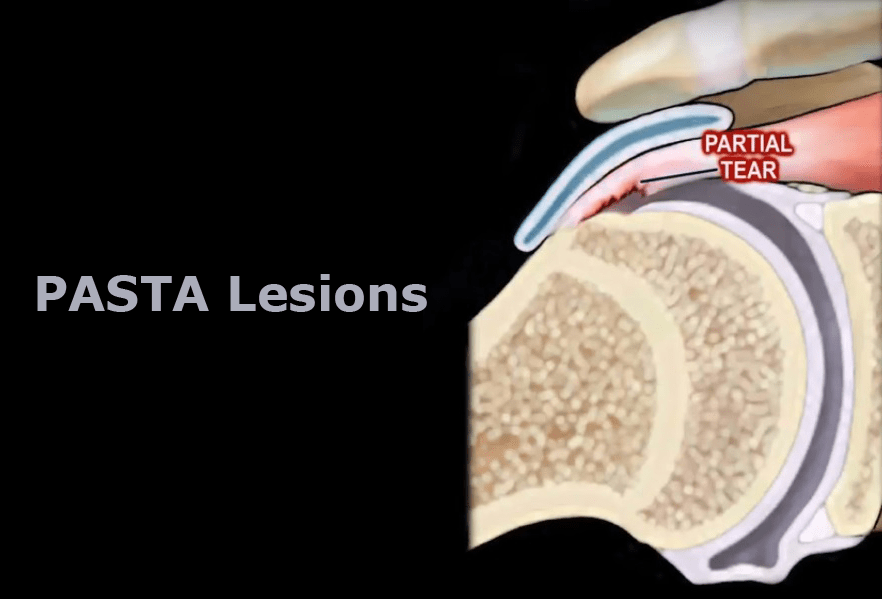
Avulsion: An avulsion injury refers usually to a traumatic injury which has had some sort of pulling force applied.
Simply put, it is partial tear in one of the rotator cuff tendons of the shoulder (usually supraspinatus).
Cause of PASTA lesions
PASTA lesions are very common type of rotator cuff pathology. It is generally seen in athletes under the age of 45 involved in contact or throw sports. Main cause of PASTA lesion is twisting or pulling of the shoulder. It can also be caused by any traumatic and forceful fall or ageing. PASTA lesions can be present with pain when lifting outwards, overhead and throwing. Fatigue of the shoulder on account of overhead activities is common. PASTA lesions can also be found in younger people and people who smoke.
Symptoms of PASTA lesions
Excruciating pain while lifting the arm overhead, outward or in a throwing gesture and weakness in the shoulder after performing activities that involve overhead lifting repeatedly are the common signs that signify PASTA lesion.
Diagnosis of PASTA lesions
Clinical diagnosis of PASTA lesions can be challenging as not all PASTA lesions show symptoms. Though the natural history of PASTA lesions remain vague, tendon tear is generally associated with pain and disability. Pain is generally present in the arc of motion between 60° and 120°. Pain is generally triggered by resisted abduction with the shoulder positioned at 90° of abduction. It has been clinically proven that more that 50% of the PASTA lesions tend to enlarge. When doctor examines the patient suspected to have PASTA lesion, pain may be felt during the Empty Can (Jobe) Test or the LaFosse test. The tear can be seen on ultrasound scan or plain MRI scan. However, MRI scan or MR Arthrogram (where dye is injected into the joint before the scan) taken in a special position called the ABER (ABduction and External Rotation) position is more accurate. The ABER MRI scan is taken with the arm above the patient’s head in the scanner.
PASTA lesion can be precisely diagnosed at key-hole surgery (arthroscopy).
Treatment
Treatment of the PASTA lesions varies in accordance with the stage and pathology. Generally it begins with conservative treatment. However, when more than one half of the thickness of the supraspinatus tendon is torn (Ellman or Snyder Grade 3) operative procedure in symptomatic patients is indicated. The final choice of treatment modality for the treatment of PASTA lesions is based on factors such as clinical evaluation, imaging findings, and classification of the tear.
Treatment options are either conservative or surgical.
Conservative treatment
Conservative treatment generally begins with physical therapy. Rest or activity modification with the avoidance of movements that cause pain is the first line of treatment. Pain and inflammation can be contained with the help of oral non-steroidal anti-inflammatory drugs. In some cases corticosteroids may also be prescribed for pain relief. However, it is important to note that both non-steroidal anti-inflammatory and corticosteroid drugs may have harmful effects on long-term tendon healing.
When conservative treatments fail bring the desired result, surgery is generally required.
Surgical treatment
Surgery is usually suggested if the patient’s pain is not coming down by three to six months of nonoperative treatment, including activity modification, avoidance of overhead or pain-provoking actions, NSAID use, physical therapy, strengthening, and subacromial or glenohumeral steroid injections.
There are various surgical options including:
1) Debridement in isolation
2) Debridement with an acromioplasty
3) Rotator cuff repair
Before zeroing in on a surgical procedure, factors such as the size of the tear, the patient’s age and the level of activity of the person are taken into account.
Every case is different, so is the recovery after surgery. Success of recovery depends on several factors, including repair techniques, healing process related to timing, rehabilitation programs, and patient compliance with home exercises.
For questions related to PASTA Lesions, send a message to www.BangaloreShoulderInstitute.com/contact
Q and As – Pasta Lesions
1. What is a PASTA lesion?
PASTA lesion is an acronym for Partial Articular Supraspinatus Tendon Avulsion. It is a very common rotator cuff injury. It mainly affects overhead athletes, younger people, and people who smoke. PASTA lesions cause pain and weakness in the affected shoulder.
2. What are the risk factors associated with a PASTA lesion?
There are several risk factors that predispose certain individuals to PASTA lesions. There is a proven relationship between age and PASTA lesions. They are known to increase in frequency with age and the most common cause is age-related degeneration and, less frequently, sports injuries or trauma.
Smokers, diabetics, and individuals with muscle atrophy and/or fatty infiltration are also at increased risk of developing PASTA lesions. Recurrent lifting and overhead motions are at risk as well. This includes jobs that involve repetitive overhead work, such as carpenters, painters, and servers. Sports players engaged in sports that involve overhead motions, such as swimming, volleyball, baseball, tennis, rugby, shot put, and javelin throwers are at considerable risk.
3. What are the treatment options available for PASTA lesions?
For most cases, the initial treatment for PASTA lesion is nonsurgical and involves several modalities like:
- Rest. If the tear is due to overuse, resting the shoulder may help.
- Physiotherapy to strengthen and train the muscles.
- Strengthening and stretching exercises, as part of a physical therapy program, are recommended.
- Corticosteroid injections can help reduce pain but cannot be repeated frequently because they can also weaken the tendon.
If the symptoms continue despite the conservative treatment, then surgical reattachment of the damaged portion may be appropriate. This is performed using arthroscopic techniques like arthroscopic debridement of the tear with or without acromioplasty, tear completion and repair, and transtendinous in situ repair.
4. What are the diagnostic tests performed for PASTA lesions?
There are several physical and imaging tests done to conclusively arrive at a diagnosis of PASTA lesion. No single physical examination test distinguishes reliably between inflamed bursae, partial-thickness, and full-thickness tears.
- Codman’s test is performed as one of the physical tests for the diagnosis of a PASTA lesion. The arm is raised to the side to 90° by the examiner. The injured individual then attempts to look to lower the arm back to neutral, palm down. If the arm drops suddenly or pain is experienced, the test is considered positive.
- Radiographs from various angles and views are used.
- Ultrasound imaging is an appropriate technique for the assessment of PASTA lesions.
- MRI techniques have improved the ability to detect PASTA lesions.
5. What are the signs and symptoms associated with PASTA lesions?
The signs and symptoms seen in PASTA lesions are often similar to other rotator cuff conditions and it may be difficult to distinguish them. The symptoms seen are:
- Recurrent, constant pain. Particularly with overhead activities.
- Pain at night which prevents one from being able to sleep on the affected side.
- Muscle weakness, especially when attempting to lift the arm above shoulder height.
6. Why does my shoulder feel weak even though scans show only a “partial” tear?
This is something patients often find confusing at first. The term “partial” can sound reassuring, but on the shoulder, it does not always reflect how the joint performs. A PASTA lesion affects the inner portion of the tendon where much of the load is transmitted during movement. Even a partial disruption here can interfere with how force is generated and transferred.
In practical terms, the muscle may still contract, but the connection to the bone is no longer efficient. That is why everyday tasks begin to feel unexpectedly difficult. You might notice reduced control when lifting the arm or a sense that strength fades quickly with repeated use. This is not simply deconditioning. It reflects a mechanical inefficiency caused by the tendon not anchoring as it should.
7. Is it normal for symptoms to come and go with a PASTA lesion?
Yes, and this pattern often leads people to delay seeking advice. Symptoms tend to fluctuate depending on activity levels. After a period of rest, inflammation settles, and the shoulder feels manageable. Once normal use resumes, the same underlying weakness and irritation are exposed again.
Patients often describe this as a cycle of improvement followed by relapse, sometimes triggered by something as simple as lifting a bag or reaching overhead. The important point is that temporary relief does not mean the tendon has healed. Without targeted rehabilitation, the same cycle tends to repeat, and over time, the flare-ups may become more frequent or more intense.
8. Why do certain arm positions suddenly trigger sharp pain?
This comes down to how the tendon moves within the joint. The articular surface of the tendon is exposed to compression during specific movements, particularly when the arm is elevated and rotated. In a healthy shoulder, this is well tolerated. When part of the tendon is already damaged, that same movement places stress directly on a vulnerable area.
Patients often identify a very specific position that reliably produces pain. It may be reaching behind to fasten clothing or lifting the arm out to the side. The sharpness of the pain reflects mechanical irritation rather than general inflammation. Recognising these positions helps guide both diagnosis and rehabilitation.
9. Can this condition affect coordination as well as strength?
Yes, and this aspect is sometimes overlooked. The rotator cuff plays a stabilising role, keeping the head of the upper arm centred within the socket during movement. When part of the tendon is compromised, that fine control is disrupted.
You may still be able to generate strength in a straight line, but controlled or precise movements feel less reliable. Patients sometimes describe a sense of uneven motion or hesitation when lowering the arm. This is not simply a weakness. It reflects altered muscle timing and joint control, which is why rehabilitation focuses on both strength and coordination.
10. Why does resting alone not always solve the problem?
Rest can reduce irritation in the short term, but it does not address the underlying issue. The tendon remains structurally compromised, and the surrounding muscles may lose conditioning during prolonged inactivity. When activity resumes, the same stress returns to an already weakened system.
This explains why symptoms often settle briefly and then return. Effective recovery requires a gradual reintroduction of movement with targeted strengthening. The aim is to restore balance around the shoulder so that the injured tendon is not overloaded again. Simply avoiding activity rarely leads to lasting improvement.
11. Can a PASTA lesion affect both shoulders?
It is less frequent, but it does happen. When the underlying cause relates to movement patterns or posture rather than a single injury, both shoulders can be exposed to similar stresses over time. This is often seen in individuals whose work or daily routine places repeated demand on the same range of motion.
When both sides are involved, treatment becomes slightly more complex. We look beyond the tendon itself and focus on correcting the broader mechanics of how the shoulders are used. Addressing only one side without modifying those patterns may lead to persistent or recurring symptoms.
12. Why does my shoulder feel stiff even though this is not a frozen shoulder?
The stiffness in this situation is usually protective rather than structural. The body limits movement to avoid provoking pain from the injured tendon. This gives the impression that the joint is restricted, even though the passive range of motion is often still available when examined.
Over time, if inflammation continues, this protective behaviour can lead to secondary stiffness. That is why early management is important. By reducing pain and restoring controlled movement, we prevent the shoulder from becoming truly stiff, which would complicate recovery.
13. Does the size of the tear always match the level of pain?
Not always, and this is an important point when reviewing scan results. Pain is influenced by several factors, including inflammation, activity level, and individual sensitivity. A relatively small tear in an active individual may produce significant symptoms, while a larger tear in someone less active may go relatively unnoticed.
This is why treatment decisions are not based on imaging alone. We consider how the shoulder functions in daily life, what movements are affected, and how symptoms are evolving. The clinical picture often provides more useful information than the scan in isolation.
14. How does daily posture influence this type of tendon injury?
Posture has a direct effect on how forces are distributed across the shoulder. When the shoulders are habitually positioned forward, the mechanics of the joint change. The tendon is placed under altered tension, particularly on its inner surface, which is already the weaker side in a PASTA lesion.
Over time, this repeated strain contributes to ongoing irritation and can slow recovery. Patients are often surprised at how much improvement comes from simple adjustments, such as repositioning the workstation or being more aware of shoulder positioning during the day. These changes reduce unnecessary stress on the tendon and support healing.
15. What should I expect if the condition is managed correctly?
With appropriate care, most patients experience a steady and meaningful improvement in both pain and function. Early cases often respond well to a structured rehabilitation programme that restores strength and control around the shoulder. Progress is gradual rather than immediate, but it is usually consistent when the plan is followed properly.
In situations where the tear is more significant, further intervention may be considered, but outcomes remain favourable when treatment is tailored to the individual. The key is not rushing the process. Allowing the tendon time to adapt and regain strength reduces the risk of recurrence and supports long-term shoulder health.