
Thoracic Outlet Syndrome
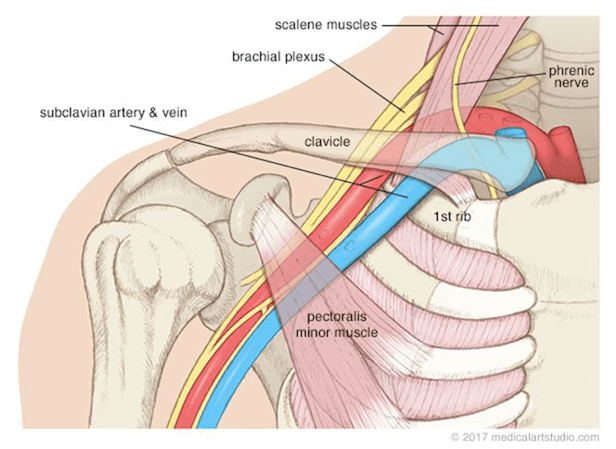
Thoracic Outlet Syndrome is a condition that occurs when blood vessels, arteries or veins in the space between your collarbone & first rib are compressed
Thoracic Outlet Syndrome
Thoracic Outlet Syndrome (TOS) is a condition that occur when blood vessels, arteries or veins in the space between your collarbone and your first rib (thoracic outlet) are compressed. There are three main types of this syndrome – neurogenic, venous and arterial. The neurogenic type is the most common type and is caused by compression of components of brachial plexus nerves. Arterial type of Thoracic Outlet Syndrome is rare and is caused due to compression of subclavian artery. Venous type is extremely rare type of TOS and is caused due to compression of subclavian vein.
Symptoms of Thoracic Outlet Syndrome
Symptoms may vary depending on which nerves or blood vessels are compressed. However, common symptoms include neck and shoulder pain, arm pain, numbness and tingling of the fingers and impaired circulation to the extremities. Compressed blood vessels cause swelling, redness and weakness of the arms.
These symptoms may worsen when the thoracic outlet is narrowed in certain body positions like when the arm is raised overhead.
TOS can also lead to eye problems including vision loss because of vertebral artery compression. Some other complications that can be caused by Thoracic Outlet Syndrome are Ischemic ulcers of the fingers, Gangrene, Pulmonary embolism and neurogenic complications such as permanent nerve damage.
Causes
Congenital problem like extra first rib (cervical rib)
Certain trauma like a car accident
Drooping Shoulders
Old fracture of the clavicle (collarbone)
Bony and soft tissue abnormalities
Unknown causes
It is more common in women and occurs commonly between 20 and 50 years of age.
Other risk factors include
Sleep disorders
Obesity
Tumors that press on nerves
Stress
Repetitive arm and shoulder movements
Repetitive injuries from carrying heavy shoulder loads
Injury to the neck or back
Poor posture
Pregnancy
Weight lifting
Treatment for Thoracic Outlet Syndrome
Treatment depends on what caused your Thoracic Outlet Syndrome and generally does not include surgery
Non-steroidal anti-inflammatory drugs are given to reduce the swelling and pain so that patient can be put on physical exercises
Physical Therapy is mainly recommended to strengthen the muscles surrounding the shoulder. Some postural exercises are also taught to improve the overall posture which helps reduce pressure on the nerves and blood vessels.
Doctor will advise you to stop certain strenuous activities and recommend certain changes in the lifestyle.
Surgery
Surgery is advised if all non-surgical treatments fail to relieve the symptom. It is estimated that only 10 to 20% of patients with TOS need surgical treatment. It is often microsurgery which is performed to remove portion of abnormal first rib or to release muscles that joint the neck and chest, or to reroute blood vessels around the thoracic outlet.
Physical therapy is often used before and after the surgery to improve recovery.
Prevention of Thoracic Outlet Syndrome
Practicing proper posture while sitting and standing
Taking breaks at work
Maintaining a healthy weight
Not sleeping with arms above your chest
Performing strengthening exercises
Avoiding lifting heavy objects
For questions related to Thoracic Outlet Syndrome, you can write to www.bangaloreshoulderinstitute.com/contact
Q&As Thoracic outlet syndrome
- What are the types of thoracic outlet syndrome?
- Thoracic outlet syndrome is a group of disorders resulting from compression of the bundle of nerves and blood vessels, both arteries and veins, present in the space between collar bone (clavicle) and the first rib.
- Depending on which structure is getting compressed, there are 3 types of thoracic outlet syndrome:
- Neurogenic (neurological) TOS – This is the most common type of TOS. The bundle of nerves (called brachial plexus) that passes through the space between the collar bone and the first rib is compressed in this. It causes neck and shoulder pain, numbness or tingling in the arm or fingers, weakening grip.
- Venous TOS – This is caused by a compression of the veins in the region. The affected arm has pain and swelling, bluish discoloration or paleness in one or more fingers, or throbbing mass in the collar bone region. There is usually a blood clot in the compressed vein.
- Arterial TOS – This is the rarest type of TOS. When there is compression of the arteries in the region, it causes cold arms, fingers, and hand, pain in the affected arm or hand, paleness or discoloration of the fingers or the entire hand, and weak or no pulse in the arm. This is usually due to a congenital (present at birth) abnormality where the individual has an extra first rib or cervical rib.
- How do you test for thoracic outlet syndrome?
- The diagnosis of thoracic outlet syndrome is difficult, and some individuals may live with it undiagnosed for a long time. Doctors do a thorough physical examination with a detailed medical history of the symptoms to arrive at the diagnosis.
- It is important to rule out other conditions which present with similar symptoms.
- Apart from a physical examination, an ultrasound, computed tomography (CT) scan, Magnetic Resonance Imaging (MRI), arteriography or venography, and nerve conduction studies are done to diagnose the various types of thoracic outlet syndrome.
- How is thoracic outlet syndrome treated?
- Most cases of thoracic outlet syndrome respond to non-surgical treatment, which consists of:
- Physical therapy – For neurogenic TOS, this is the best, and the first treatment advised. Exercises to slowly strengthen and stretch the shoulder muscles to open the thoracic outlet are taught to the patient. This is effective in most cases.
- Medication – Individuals with TOS shall be prescribed with painkillers for pain relief, muscle relaxants to aid muscle relaxation, and anti-inflammatory medication to decrease inflammation. Thrombolytics like warfarin and heparin are prescribed in case of blood clots to help dissolve them. Doctors also prescribe blood thinners to prevent further blood clots to form.
- Surgery – It is rarely needed but if physical therapy and medication do not provide relief, surgical options are explored. It is called decompression surgery.
- What causes thoracic outlet syndrome?
- Thoracic outlet syndrome is most commonly caused by repetitive arm or shoulder movements, especially overhead movements. Poor posture like drooping shoulders also causes TOS.
- A congenital anomaly like the extra first rib or cervical rib puts pressure on the artery in the thoracic outlet and causes arterial TOS.
- Pregnancy can also be a cause for it. Women and individuals between the ages of 20 to 50 years are at higher risk of developing TOS.
- What happens if thoracic outlet syndrome is left untreated?
- If thoracic outlet syndrome is left untreated, it can cause increased pain and discomfort. It can also cause decreased function.
- In the case of arterial and venous TOS, it can cause massive, life-threatening blood clots.
6. How can thoracic outlet syndrome be distinguished from a cervical spine problem?
Neck disc problems and thoracic outlet syndrome can both produce arm pain and tingling. The difference lies in the pattern and behaviour of symptoms. Cervical nerve root irritation often follows a clear dermatome distribution and may worsen with neck extension or sustained head movement.
Thoracic outlet symptoms are more commonly distributed across the entire arm or hand, rather than in a dermatomal pattern. Patients frequently describe heaviness, clumsiness or fatigue rather than sharp shooting pain. Symptoms are typically provoked by arm elevation, carrying loads or prolonged overhead posture rather than by neck movement alone.
On examination, reflex changes and clear motor weakness suggest cervical nerve root involvement. In contrast, thoracic outlet findings are often subtle and posture dependent. Reproduction of symptoms during arm positioning tests may support the diagnosis.
Electrodiagnostic studies may confirm nerve root compression in the neck, while cervical spine imaging can identify disc or bony pathology. In many cases, both conditions may coexist. Careful assessment avoids misdiagnosis and unnecessary treatment. Each case must be evaluated individually to ensure safe and accurate management.
7. Why do some patients experience hand weakness in thoracic outlet syndrome?
Hand weakness occurs when nerve fibres supplying the intrinsic hand muscles are chronically compressed. The lower portion of the brachial plexus carries signals to the small muscles responsible for fine movements and grip control. Prolonged pressure can reduce nerve conduction efficiency.
Initially, patients notice fatigue when writing, typing or holding objects. Later, grip strength may reduce. In advanced neurogenic cases, visible thinning between the thumb and index finger may develop. This represents muscle wasting due to reduced nerve input.
Weakness is a sign that the condition has progressed beyond intermittent irritation. At this stage, a thorough evaluation is important. Early medical intervention can prevent permanent loss of function. Weakness should never be ignored, particularly if accompanied by persistent numbness.
Prompt specialist assessment allows confirmation of diagnosis and discussion of appropriate management. The aim is always to protect nerve health and prevent long-term impairment.
8. Can thoracic outlet syndrome affect circulation as well as nerves?
Yes. In certain cases, compression involves the subclavian vein or artery rather than the nerves. Venous compression may lead to arm swelling, heaviness and a bluish colour after activity. In severe cases, a clot can develop. This requires urgent medical attention. Arterial compression is less common but more serious. Reduced arterial flow may cause coldness, colour change or pain during exertion. Rarely, prolonged compression can damage the artery wall.
These vascular forms differ from the more common neurogenic type. They often present more dramatically and require imaging focused on blood vessels. Management decisions depend on the severity and type of involvement. Any sudden swelling, colour change or severe pain in the arm should be assessed urgently to exclude a vascular complication.
9. Why does posture play such an important role in thoracic outlet syndrome?
The thoracic outlet is influenced by shoulder position. Rounded shoulders and forward head posture reduce the space between the collarbone and first rib. Modern desk work encourages this alignment for many hours daily. Over time, shortened chest muscles and weakened upper back muscles alter shoulder mechanics. This shifts pressure onto the structures passing through the outlet.
Postural correction alone can significantly reduce symptoms in early cases. Strengthening the scapular stabilisers and stretching tight anterior muscles restores balance and improves space around the neurovascular bundle. Addressing posture is therefore not cosmetic advice but a core part of management.
10. When is surgery considered in thoracic outlet syndrome?
Surgery is not the first step for most patients. It is considered when structured conservative treatment fails or when vascular compromise is confirmed. The decision depends on symptom severity, duration and objective findings.
For neurogenic cases, several months of guided rehabilitation are usually recommended before surgical discussion. If weakness progresses or symptoms severely limit function despite appropriate therapy, operative decompression may be discussed.
Vascular cases may require earlier intervention, particularly if thrombosis or arterial compromise is present. Surgery aims to relieve compression by removing contributing structures, such as part of the first rib or tight muscle segments. As with any operation, risks and benefits must be weighed carefully. The decision is individualised and based on a detailed assessment rather than imaging alone.
11. Can exercise make thoracic outlet syndrome worse?
Unsuitable exercises, particularly heavy overhead lifting without supervision, can aggravate symptoms. Targeted rehabilitation under guidance is beneficial and forms the mainstay of treatment.
12. When should urgent medical care be sought?
Sudden arm swelling, severe pain, colour change or progressive weakness requires immediate medical assessment to exclude vascular complications or significant nerve involvement. Same in depth
13. Why is Thoracic Outlet Syndrome often difficult to diagnose accurately?
Thoracic Outlet Syndrome presents diagnostic challenges because its symptoms overlap with more common conditions such as cervical radiculopathy, shoulder impingement, peripheral nerve entrapment and even carpal tunnel syndrome. Neurogenic Thoracic Outlet Syndrome does not always produce definitive findings on standard nerve conduction studies. Symptoms may fluctuate and are often position dependent, which can lead to inconsistent examination findings.
Provocative manoeuvres performed during clinical examination can reproduce symptoms, but these tests are not diagnostic in isolation. Imaging such as ultrasound, CT angiography or MRI may show anatomical narrowing, yet structural narrowing alone does not confirm symptomatic compression.
Accurate diagnosis, therefore, relies on correlation. The clinician must integrate history, symptom pattern, physical findings and imaging results. For example, numbness on the ulnar side of the hand, combined with aggravation of posture-related symptoms, may support a neurogenic diagnosis. In vascular forms, duplex ultrasound or angiographic imaging is essential to assess dynamic vessel compression.
Early identification of venous thrombosis or arterial compromise is critical to prevent long-term complications. Diagnosis requires careful exclusion of alternative causes. Rushed labelling of Thoracic Outlet Syndrome without structured evaluation can lead to inappropriate treatment.
14. What causes Thoracic Outlet Syndrome, and who is most at risk?
Thoracic Outlet Syndrome may arise from congenital, traumatic or functional factors. Some individuals are born with anatomical variations, such as a cervical rib or abnormal fibrous bands, that reduce available space. Trauma can also alter anatomy. Previous clavicle fractures, whiplash injuries or repetitive overhead strain may lead to muscle hypertrophy or scar tissue formation that compresses neurovascular structures. Occupational and sporting activities involving sustained overhead positioning, heavy lifting, or repetitive arm elevation increase risk. Competitive swimmers, weight trainers and manual workers are examples. Postural factors play a substantial role: rounded shoulder posture and forward head alignment narrow the costoclavicular space, particularly in sedentary individuals.
Venous Thoracic Outlet Syndrome is often associated with vigorous upper limb activity, especially in young active adults. Arterial forms are more frequently linked to structural anomalies. Women between early adulthood and middle age are diagnosed more often with neurogenic forms, although the condition affects both sexes. Risk assessment must consider anatomy, occupation, sport, prior trauma and symptom pattern. Identifying contributing factors is central to targeted management and prevention of recurrence.
15. Is Thoracic Outlet Syndrome a permanent condition?
Not necessarily. Many patients improve significantly with physiotherapy and activity modification. Persistent cases require further assessment.
16. Can poor posture alone cause Thoracic Outlet Syndrome?
Poor posture can contribute to narrowing of the outlet, especially in neurogenic forms, but it is usually one factor among several.
17. Is Thoracic Outlet Syndrome dangerous?
Neurogenic forms are rarely life-threatening. Venous or arterial forms require urgent assessment to prevent vascular complications.