

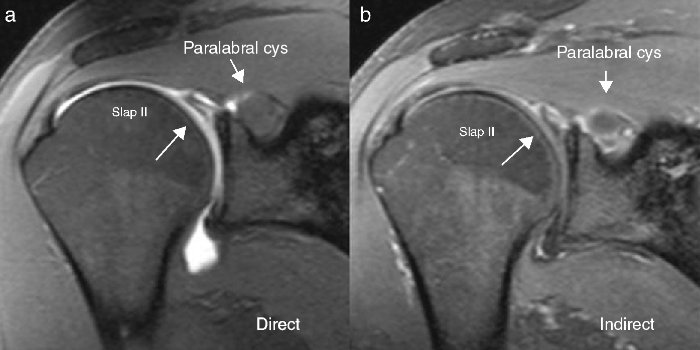
More often than not, paralabral cysts of the shoulder are an infrequent finding on MRI or MR Arthrogram. However, it is a significant diagnosis as they may cause a compression neuropathy of the suprascapular or axillary nerves depending on where they occur, along with a variety of other symptoms. About 2-4% of the general population is likely to have it and presentation may be common in males (especially around the third to fourth decades). On average, this cyst measures 10–20 mm in diameter and are located mainly on the posterosuperior aspect of the glenoid. These cysts may represent a synovial cyst, ganglion cyst or pseudocyst. The person with paralabral cyst has an increased risk of having glenoid labral tears
What are paralabral cysts?
Paralabral cysts are swellings that develop around the socket of the shoulder joint. Direct communication between a cyst and joint is not commonly seen. A paralabral cyst is termed when a focal well-defined collection of fluid is seen outside the joint under tears of the labrum. They can occur anywhere around the joint and can be unilocular (single-chambered) or multilocular (having many compartments or cavities). Paralabral cysts as such may not give rise to pain but the presence of labral tears accompanied with the cysts give rise to pain. These cysts may become large and impinge some of the important nerves around the shoulder. As a result of this, pain coupled with weakness of the muscles supplied by the nerves is a common symptom. The commonest nerve affected is the suprascapular nerve. The suprascapular nerve can be compressed at the spinoglenoid notch or at the suprascapular notch, leading to suprascapular nerve palsy. Paralabral cysts are generally noted along the posterior, superior, and anterior aspects of the glenohumeral joint. Ironically, they are unlikely to be in the inferior part of the joint. These cysts are rarely to be diagnosed clinically unless they cause compression of the surrounding structures, like nerve.
Diagnosis of paralabral cyst:
Patients suffering from paralabral cyst have chronic shoulder pain as the chief complaint. It requires an MRI or MR Arthrogram to find out if it is as a consequence of a paralabral cyst. In the absence of nerve compression symptoms it is a tad difficult to zero in on the diagnosis unless there is an image that supports the diagnosis. Knowledge of the clinical condition and its imagine features is critical for a correct diagnosis of this unusual cause of chronic shoulder pain.
In most of the cases paralabral cysts are noted around the shoulder girdle. These cysts are believed to develop when a labral or a capsular tear allows synovial fluid to be forced into the tissues, creating a one-way-valve effect. Orthopaedic literature reveals that paralabral cysts of the shoulder mostly present with symptoms of entrapment or compression of the nerve. In the absence of nerve entrapment or compression symptoms, paralabral cysts of the shoulder are not often considered when a patient presents with chronic shoulder pain.
Despite an improved recognition of paralabral cysts, however, the diagnosis of these lesions remains elusive. What makes the diagnosis challenging is the unspecific history as well as the presence of potentially confusing conditions such as rotator cuff disease, SLAP lesions, impingement syndrome and occult instability. Conservatively, shoulder pain in the glenoid labral area is attributed to SLAP lesions and compression of nerve. Generally when a patient presents with chronic shoulder pain, the first-line of treatment that a shoulder specialist recommends is rest and activity modification. The possibility of paralabral cysts is commonly considered after weighing the chances of osteoarthritis, rheumatoid arthritis, osteomyelitis, malignant neoplasms or benign bone lesions.
The exact origin and development of paralabral cysts are not well known, nor is the infective agent that causes paralabral cysts. It is believed that trauma results in tearing of the capsulo-labral complex causes these cysts to develop. In some cases paralabral cysts can be an indicator of labrocapsular injury and instability, so effort should be taken for a careful history and a thorough physical examination to detect instability. Patients with pralabral cysts are likely to have chronic pain even at rest.
Treatment of paralabral cysts:
Treatment of the condition is dependent upon the extent of pain and loss of function. If the patient does not have pain, shoulder rehabilitation to maximize function is the only treatment modality that is required. However, if the pain is present with impairment of shoulder function surgery is required. Treatment for paralabral cysts causing nerve compression involves arthroscopic repair of the labral tear, as well as decompression of the nerve and drainage of the cyst. Labral repair has been reported to reduce the frequency of paralabral cysts coupled with improvement in pain and shoulder function.
Conclusion:
To conclude, it is imperative for shoulder specialists to maintain an index of suspicion for paralabral cyst with labral tear in patients present with chronic shoulder pain that is refractory to other treatment modalities. Timely recognition and treatment of these lesions can lead to a successful clinical outcome and avoid the potential danger of missed chronic lesions.

For enquiries related to Paralabral Cyst in the shoulder, send your messages to www.BangaloreShoulderInstitute.com/contact
Q and As – Paralabral Cyst on the Shoulder
1. What are the causes of a paralabral cyst on the shoulder?
A paralabral cyst is a small collection of fluid beneath the skin from the shoulder joint. These cysts originate from tears in the labrum of the shoulder. The labrum is the cartilage of the shoulder joint that encircles the socket to stabilize the shoulder. These are also called ganglion cysts of the shoulder.
The most common cause of a cyst of the shoulder is a labral tear. Labral tears, such as a SLAP tear that cause a paralabral cyst, can occur due to trauma (dislocation), repetitive movement, sport, and age.
2. How is a paralabral cyst of the shoulder treated?
Most paralabral cysts do not need treatment. However, cysts that cause pain due to pressure on surrounding structures need treatment.
Initially, conservative treatment options like physiotherapy and aspiration are prescribed. Paralabral cyst shoulder aspiration is used as the first-line intervention for a paralabral cyst of the shoulder. Aspiration involves draining the cyst. Cyst aspiration is done under ultrasound guidance.
If these treatments fail to work, then surgery may be needed. Paralabral cyst arthroscopy surgery involves draining the cyst and repairing any associated labral tear.
3. What are the symptoms of a paralabral cyst on the shoulder?
Most paralabral cysts do not need treatment. However, cysts that cause pain due to pressure on surrounding structures need treatment.
Initially, conservative treatment options like physiotherapy and aspiration are prescribed. Paralabral cyst shoulder aspiration is used as the first-line intervention for a paralabral cyst of the shoulder. Aspiration involves draining the cyst. Cyst aspiration is done under ultrasound guidance.
If these treatments fail to work, then surgery may be needed. Paralabral cyst arthroscopy surgery involves draining the cyst and repairing any associated labral tear.
4. What are the symptoms of a paralabral cyst on the shoulder?
Generally, paralabral cysts do not cause any problems. However, if the cysts grow in size and press on important surrounding structures such as nerves or tendons, it causes some symptoms.
Cysts that form at the back of the shoulder can press on the suprascapular nerve causing pain at the back of the shoulder and weakness and wasting of the muscles.
If the cyst grows at the bottom of the shoulder joint, it can cause pressure on the axillary nerve. This can lead to pain in the affected armpit and lead to wasting of a part of the deltoid muscle.
5. How long is the recovery period for shoulder arthroscopy surgery?
Recovery from a paralabral cyst arthroscopic surgery can take 1 to 6 months. One is required to wear a sling for the first week or longer. Some medication to control the pain is prescribed. Concurrent physical therapy helps regain motion and strength sooner.
6. How is a paralabral cyst on the shoulder diagnosed?
The diagnosis of a paralabral cyst of the shoulder is complicated because the pain caused by it can be difficult to differentiate from other causes of shoulder pain like rotator cuff pain, frozen shoulder, or nerve inching from the neck.
One feature of pain from a cyst is that it is constant pain and not made worse by movement and there is muscle wasting seen commonly.
An MRI scan shows the cyst clearly and whether it is compressing the adjacent nerve. Often, muscle wasting is also seen clearly on MRI showing atrophy of the muscle and build-up of fat. MRI also helps rule out other causes of shoulder pain.
An ultrasound can also show a shoulder ganglion cyst and the effects of muscle wasting. In addition, it can help with directing a needle for injection for treatment.
7. Can a paralabral cyst in the shoulder cause clicking or catching sensations?
Yes, it can. Many patients notice clicking, catching, or a feeling that the shoulder is not moving smoothly. This commonly occurs when the cyst develops alongside a labral tear, involving the cartilage rim that surrounds and stabilises the shoulder socket. The damaged cartilage can make the joint feel unstable during overhead movements, lifting, throwing, or reaching behind the back. Some people describe it as a deep mechanical discomfort rather than sharp pain. If these symptoms continue or begin affecting strength and function, a specialist assessment is sensible to check for associated labral damage or nerve irritation.
8. Why do some people have a paralabral cyst without knowing it?
Not every paralabral cyst causes symptoms. Small cysts are sometimes discovered incidentally during an MRI scan performed for another shoulder problem. A cyst may remain silent if it is not pressing on nearby nerves or interfering with shoulder movement. The shoulder joint has limited space, however, so symptoms can develop later if the cyst enlarges or if the associated labral tear becomes more unstable. This is why scan findings are always interpreted alongside a patient’s symptoms, examination findings, and activity level rather than treated in isolation.
9. Can gym workouts or sports make a paralabral cyst worse?
Repetitive overhead activity can aggravate both the labral tear and the cyst itself. Weight training, swimming, racquet sports, cricket bowling, volleyball, and throwing sports place significant stress on the shoulder socket and rotator cuff. If the labrum continues to experience strain, joint fluid may repeatedly track into the cyst and increase pressure within the area.
Patients often notice worsening pain after exercise, reduced endurance, or weakness during pushing and lifting movements. Modifying activity early and starting appropriate rehabilitation may help prevent progression.
10. What does paralabral cyst pain usually feel like?
Many people describe the discomfort as a deep, internal ache in the shoulder instead of pain felt on the outer surface. Some patients feel discomfort at the back of the shoulder blade, while others notice pain during overhead movement or when sleeping on the affected side. If the cyst compresses the suprascapular nerve, there may also be weakness, fatigue, or a heavy sensation in the arm. Unlike a simple muscular strain, symptoms from a paralabral cyst can persist even during rest because the problem comes from pressure inside the joint region rather than only muscle inflammation.
11. Can a paralabral cyst lead to permanent shoulder weakness?
It can if nerve compression is ignored for too long. A larger cyst may compress the suprascapular nerve, which supplies important rotator cuff muscles responsible for lifting and rotating the arm. Continued pressure can lead to muscle wasting and long-term weakness.
Early diagnosis is important because nerves recover better when compression is relieved before significant damage develops. Patients who notice visible muscle thinning around the shoulder blade, difficulty lifting the arm, or sudden loss of strength should seek specialist review rather than continuing through the pain.
12. Is physiotherapy useful for a paralabral cyst?
Physiotherapy can be very effective in selected cases, especially when symptoms are mild and there is no significant nerve involvement. Treatment usually focuses on improving shoulder mechanics, rotator cuff strength, posture, and scapular control. Strengthening the muscles around the shoulder may reduce strain on the injured labrum and improve overall function.
However, physiotherapy cannot physically remove the cyst itself. If there is ongoing nerve compression, persistent weakness, or failure to improve with rehabilitation, surgical treatment may still be required.
13. Why is an MR arthrogram sometimes recommended instead of a standard MRI?
A standard MRI can identify many paralabral cysts, but an MR arthrogram often provides greater detail when a labral tear is suspected. During this scan, contrast fluid is injected into the shoulder joint before imaging. The contrast helps outline small tears within the cartilage that may not be clearly visible on a routine MRI. Because paralabral cysts commonly develop from labral injuries, identifying the exact tear pattern is important when planning treatment and deciding whether surgery is necessary.
14. Does every paralabral cyst need surgery?
No. Treatment depends on symptoms, shoulder function, and whether nerves are involved. A small cyst causing minimal discomfort may simply be monitored alongside physiotherapy and activity modification. Surgery is generally considered when patients have ongoing pain, recurrent symptoms, weakness, muscle wasting, or confirmed nerve compression. In many cases, arthroscopic surgery addresses both the cyst and the underlying labral tear at the same time, which helps reduce the likelihood of recurrence.
15. Can shoulder instability and a paralabral cyst happen together?
Yes, they are commonly related. Repeated shoulder instability, partial dislocations, or previous injuries can damage the labrum and create the pathway through which joint fluid escapes to form a cyst. Patients with instability often describe the shoulder feeling loose, slipping, or unreliable during movement. Treating the instability is important because simply draining the cyst without stabilising the labrum may allow the problem to return.
16. How long should shoulder symptoms be ignored before seeking medical advice?
Shoulder pain that continues for several weeks should be assessed properly, particularly when it begins to affect sleep, work responsibilities, exercise routines, or everyday movements. Early assessment becomes even more important if there is weakness, numbness, visible muscle wasting, or loss of shoulder control. Many shoulder conditions overlap in symptoms, so a specialist examination and appropriate imaging help ensure the correct diagnosis is made before long-term joint or nerve damage develops.
17. Can a paralabral cyst come back after surgery?
Recurrence is less common when both the cyst and the associated labral tear are treated together. Arthroscopic surgery aims to decompress the cyst while repairing the source of fluid leakage inside the joint. Recovery still requires proper rehabilitation and a gradual return to sport or heavy lifting. Returning too quickly to strenuous overhead activity may place stress on the healing process. Most patients do very well after treatment when the underlying instability or cartilage injury has been fully addressed.
More reading
 Link Between Diet and Arthritis
Arthritis, a condition marked by joint pain and stiffness, affects millions worldwide. While factors such as…
Read More
Link Between Diet and Arthritis
Arthritis, a condition marked by joint pain and stiffness, affects millions worldwide. While factors such as…
Read More
 Factors That Cause Shoulder Pain in Women
Shoulder pain is a widespread issue for many women, presenting as anything from a mild ache…
Read More
Factors That Cause Shoulder Pain in Women
Shoulder pain is a widespread issue for many women, presenting as anything from a mild ache…
Read More
 Common Types of Shoulder Pain and How to Identify Them
Shoulder pain affects many people regardless of age or lifestyle. The shoulder joint is highly mobile,…
Read More
Common Types of Shoulder Pain and How to Identify Them
Shoulder pain affects many people regardless of age or lifestyle. The shoulder joint is highly mobile,…
Read More
 Tips to Prevent a Gym Shoulder Injury
No matter if you're new to weight training or a seasoned gym-goer, shoulder injuries can quickly…
Read More
Tips to Prevent a Gym Shoulder Injury
No matter if you're new to weight training or a seasoned gym-goer, shoulder injuries can quickly…
Read More